

Welcome to Berlin, a city that wears its past on its sleeve and its future in neon lights. This isn’t just Germany’s capital. It’s a living, breathing museum with a pulse where cobblestone lanes echo with the footsteps of emperors, spies, artists, and revolutionaries. Let’s take you on a journey not just through Berlin’s landmarks, but through its soul. These are the top 20 places to visit in Berlin. Carefully ordered by proximity, so your exploration feels like a smooth, flowing storybook walk.

Brandenburg Gate: Berlin’s Iconic Symbol of Freedom
Standing tall in the heart of Berlin, the Brandenburg Gate is more than just a monument. It’s a historical time machine. Constructed between 1788 and 1791, this neoclassical marvel was inspired by the Propileia in Athens and once symbolized the city’s royal entrance. But it quickly became much more. From Napoleon parading through in 1806 to Nazi rallies in the 1930s to Cold War tensions as it stood just beside the Berlin Wall, the gate has witnessed Germany’s highest hopes and darkest hours.
In 1989, the world watched in awe as thousands celebrated the fall of the Berlin Wall right here, turning it into a beacon of reunification. Today, the Quadriga, a statue of the goddess of victory atop her chariot, looks over Pariser Platz as tourists, street performers, and historians gather beneath it. Whether lit up by the morning sun or glowing at night, the gate is Berlin’s eternal symbol of freedom.

Memorial to the Murdered Jews of Europe: A Haunting Tribute
A short stroll from Brandenburg Gate brings you to one of Berlin’s most haunting and important sites. This field of gray concrete slabs, 2,711 in total, undulates across 4.7 acres in silent tribute to the 6 million Jewish lives lost during the Holocaust. Designed by architect Peter Eisenman, the memorial creates an uneasy maze-like experience. As you walk deeper, the slabs grow taller, the light dims, and a quiet discomfort sets in. A subtle yet powerful metaphor for the dehumanizing descent of Europe during the Holocaust.
Beneath the field lies the information center, housing chilling personal stories, letters, and historical accounts. There are no grand statements here, just quiet, overwhelming remembrance. It’s a place that doesn’t shout, but lingers in your heart long after you leave.

Reichstag Building: Germany’s Democratic Powerhouse
Just steps from the memorial and the gate lies the political powerhouse of Germany. The Reichstag building built between 1884 and 1894. Its neo-Renaissance facade has seen empires rise, democracies fall, and history rewritten. In 1933, a fire severely damaged it, triggering the Nazis’ swift rise to absolute power. For decades, it stood in limbo, caught between East and West Berlin.
But in the 1990s, after reunification, it was reborn. Renovated by Sir Norman Foster, the Reichstag now boasts a striking glass dome symbolizing transparency in democracy. Visitors can spiral their way up the ramp inside, looking down onto Parliament sessions below. It’s one of the few places where citizens literally stand above their government, a poetic reversal of tyranny. The building is a living symbol of German resilience and a must-see for anyone wanting to understand Berlin’s political past and present.

Tiergarten: Berlin’s Green Heart and Urban Oasis
Step just beyond the Reichstag and you’ll find Berlin’s green heart, Tiergarten. Sprawling over 520 acres, this park is Berlin’s version of Central Park, Hyde Park, and a royal hunting ground all rolled into one. Originally created in the 16th century for Brandenburg’s electors to hunt deer and boar, it transformed under Frederick the Great into a public paradise filled with winding paths, tranquil lakes, and gardens. It’s home to birds, foxes, picnickers, joggers, and curious tourists all coexisting in harmony.
Within Tiergarten lies the iconic Victory Column, which can be climbed for stunning panoramic views. Not far from it, you’ll find the Berlin Zoo, one of the oldest and most diverse zoos in the world. Whether you’re lounging by a pond, cycling under leafy canopies, or tracing the steps of Prussian nobility, Tiergarten offers a serene historic escape from Berlin’s buzz.

Berlin Cathedral: Baroque Grandeur on Museum Island
Towering proudly on Museum Island, the Berlin Cathedral is more than just a place of worship. It’s a celebration of grandeur and resilience. Built between 1894 and 1905 in a lavish Baroque revival style, this Protestant cathedral was once the royal court church of the Hohenzollerns, the ruling dynasty of Prussia and later the German Empire.
Inside you’ll find a jaw-dropping interior with golden embellishments, mosaics, and one of the largest domes in Berlin. The mighty Sauer organ with over 7,000 pipes has thundered through weddings, sermons, and royal ceremonies alike. Beneath the cathedral lies the Hohenzollern crypt, the final resting place of emperors and queens, where ornate sarcophagi rest in silent tribute. Though bombed heavily in World War II and left in partial ruin during the Cold War, it was restored over decades and reopened in 1993. Climb to the dome for sweeping views over Museum Island and the Spree. It’s a climb worth every step.

Lustgarten: From Royal Gardens to Public Paradise
Just in front of the cathedral lies Lustgarten, literally translating to “Pleasure Garden.” But don’t let the name fool you. This space has seen everything from royal promenades to Nazi rallies. First laid out in the 16th century as a kitchen garden for the nearby Berlin palace, it transformed under Frederick William IV into a classical public park with fountains, manicured lawns, and scenic walkways.
In the 20th century, the Nazis used this space for massive propaganda events. And during the GDR era, it became a space for demonstrations. Today, Lustgarten is once again a place of peace where Berliners sunbathe, street musicians perform, and history lovers pause between museum visits. It’s a perfect picnic spot between the city’s grandeur and its modern rhythm.

Museum Island: UNESCO World Heritage Art Collection
Now we cross into Berlin’s intellectual heart, Museum Island. This UNESCO World Heritage site is home to five world-class museums, all packed into a single island on the river Spree. Imagine centuries of art, archaeology, and history, all within walking distance of each other.
The Pergamon Museum steals the spotlight with ancient masterpieces like the Pergamon altar and the Ishtar Gate from Babylon. The Neues Museum showcases Egyptian treasures, including the iconic bust of Nefertiti. The Alte Nationalgalerie offers romanticism and impressionism in all their moody glory, while the Bode Museum houses sculpture, coins, and Byzantine art. And don’t forget the Altes Museum, home to classical antiquities. Whether you’re a history nerd, art lover, or curious wanderer, Museum Island is a place where time blurs, where the ancient and modern dance in perfect harmony.

Berlin TV Tower: East Germany’s Towering Legacy
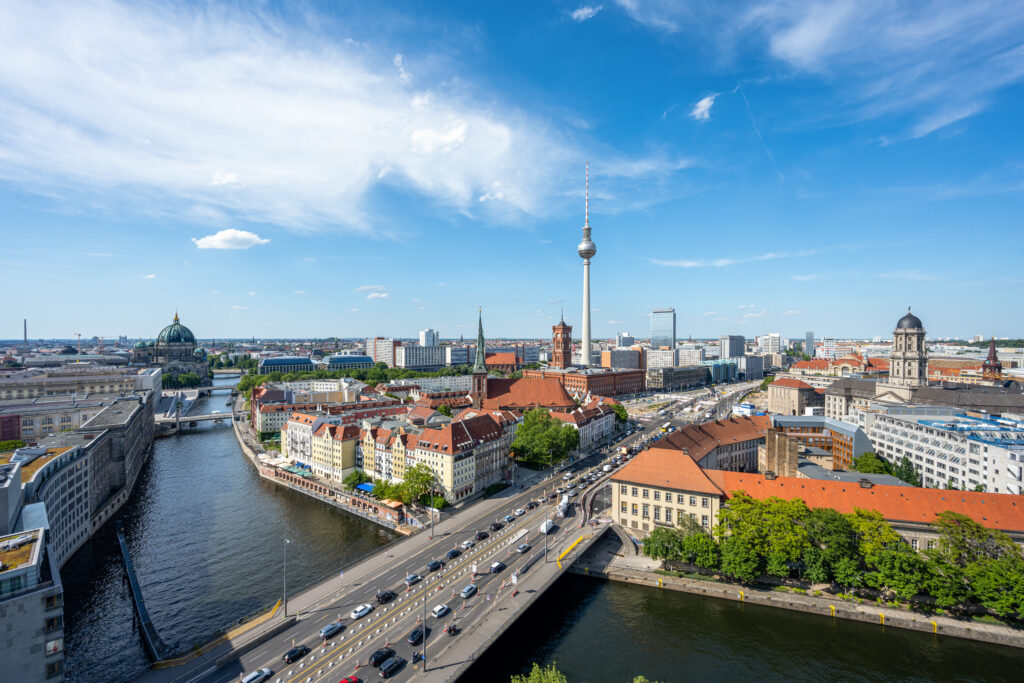
Gaze skyward from Museum Island and you’ll spot the Berlin TV Tower slicing through the skyline. At 368 meters tall, it’s the tallest structure in Germany and a sparkling symbol of East Berlin’s Cold War pride. Built between 1965 and 1969 by the GDR regime, it was meant to showcase socialist prowess. Ironically, the cross-shaped reflection of sunlight on the sphere earned it the nickname “the Pope’s revenge,” a divine wink in atheist East Germany.
Today, it’s one of Berlin’s most popular attractions. In just 40 seconds, high-speed elevators transport visitors to 203 meters, where Berlin reveals itself in a sweeping panoramic view. And if you’re feeling fancy, dine at the revolving restaurant. It completes a full rotation every 30 minutes, offering Berlin on a silver platter.

Alexanderplatz: East Berlin’s Bustling Hub
At the base of the TV tower lies Alexanderplatz, or “Alex” as the locals call it. Once a medieval cattle market, it grew into East Berlin’s commercial and cultural hub. During the Cold War, it became a showcase of socialist architecture with blocky buildings, wide-open plazas, and utilitarian design.
Today, Alex pulses with activity, trams screeching, crowds flowing, and street performers battling it out for attention. You’ll find the World Time Clock, a rotating monument showing the time in cities around the globe, and the Fountain of Friendship Between Peoples, celebrating international solidarity. Surrounding the square are modern shopping malls, food courts, and hotels, making it both a historical site and a present-day hot spot. It’s where Berliners meet, mingle, and move day or night.

East Side Gallery: The World’s Largest Open-Air Gallery
Heading east, we arrive at the longest remaining section of the Berlin Wall, now transformed into the world’s largest open-air gallery. The East Side Gallery stretches for 1.3 kilometers, adorned with over 100 murals from artists around the world. Painted in 1990, just after the wall fell, these murals burst with emotion: joy, grief, satire, and protest.
Some of the most iconic include the fraternal kiss between Soviet leader Brezhnev and East German leader Honecker and Checkpoint Charlie depictions echoing the past’s brutal reality. More than just street art, the gallery is a living memorial. A place where history, politics, and creativity crashed together in a colorful collision. A stroll here is part reflection, part rebellion, and entirely Berlin.

Oberbaum Bridge: Gothic Revival Connecting Past and Present
Just steps away from the East Side Gallery is the magnificent Oberbaum Bridge, one of Berlin’s most photogenic and symbolic structures. This double-decker Gothic revival bridge spans the Spree River and connects the districts of Friedrichshain and Kreuzberg, once separated by the wall, now joyfully united.
Built between 1894 and 1896, its striking red brick towers and ornate arches are reminiscent of a medieval castle. During the Cold War, the bridge served as a border checkpoint, a heavily guarded crossing point where east met west. Today, it carries cars below and the U1 subway line above. As trains rattle across its top level and cyclists ride beside the river, the bridge buzzes with life. Street musicians often perform under its arches and photographers gather at sunset to capture its silhouette reflected in the Spree. It’s more than just a way across. It’s a bridge between past and present.

Spree River: Berlin’s Historic Waterway
Winding like a silver thread through the fabric of Berlin, the Spree River is both a scenic feature and a historical lifeline. Stretching over 400 kilometers, it flows gently past iconic landmarks like Museum Island, the Reichstag, and the Berlin Cathedral. Since medieval times, the Spree has powered trade, fed industries, and connected communities. In the Cold War era, parts of the river became a deadly border, patrolled and fenced off.
Today, it’s reclaimed as a place of connection and relaxation. Take a boat cruise to see Berlin from a new angle, gliding under bridges, past modern architecture, and centuries-old facades. Riverbanks are lined with cafes, walkways, and grassy spots perfect for a summer chill-out. At night, the reflections of city lights in the water transform the Spree into a shimmering ribbon of magic.

Gendarmenmarkt: Berlin’s Most Elegant Square
Step into Berlin’s most elegant square, Gendarmenmarkt. Framed by architectural jewels, this plaza feels like a slice of 18th-century grace dropped into the modern world. The twin domes of the German Cathedral and French Cathedral stand opposite each other like mirror twins with the Konzerthaus Berlin, a majestic concert hall commanding the center.
Built in the 1700s, these buildings symbolize the harmony of different cultures, particularly the welcoming of French Huguenot refugees by the Prussian kings. Today, Gendarmenmarkt is a cultural hot spot. It hosts classical concerts, art events, and Berlin’s most magical Christmas market, complete with glowing tents and mulled wine. Whether you visit in the golden light of morning or under twinkling fairy lights at night, this square will steal your heart.

Bebelplatz: Where Books Burned and Memory Endures
A short walk from Gendarmenmarkt brings us to one of Berlin’s most quietly chilling spaces, Bebelplatz. This beautiful square is bordered by grand institutions like the Berlin State Opera, St. Hedwig’s Cathedral, and the Humboldt University Law Faculty. But beneath its calm exterior lies a painful memory.
On May 10th, 1933, this is where Nazi students carried out the infamous book burning, destroying the works of Jewish, liberal, and anti-fascist writers. Today, a haunting memorial lies beneath a glass pane in the cobblestones: an empty underground library with white bookshelves holding nothing, a chilling symbol of what was lost. The juxtaposition of stunning architecture and deep sorrow makes Bebelplatz a place of reflection. It’s where you stop, breathe, and remember the fragility of knowledge and freedom.

Potsdamer Platz: Modern Berlin’s Futuristic Showcase
Now we move into the energetic heart of modern Berlin, Potsdamer Platz. Once the busiest intersection in Europe in the 1920s, it was reduced to rubble during World War II and later became a no man’s land divided by the wall. But today, it’s reborn as a sleek showcase of glass towers, bustling malls, theaters, and futuristic architecture.
Here you’ll find the Sony Center with its iconic tent-like roof that lights up in neon colors at night, housing restaurants, cinemas, and even a Legoland. The square blends old with new. Fragments of the Berlin Wall still stand near the sleek buildings, reminding visitors how far the city has come. From ice skating in winter to film premieres during Berlinale, Potsdamer Platz is where Berlin shows off its modern face.

Berlin Wall Memorial: Understanding Division and Reunification
You’ve seen its pieces scattered across the city, but the Berlin Wall Memorial on Bernauer Strasse offers the most powerful and intact experience of the wall’s dark legacy. Stretching 1.4 kilometers, the memorial preserves a section of the wall as it once stood, complete with the death strip, guard tower, and no man’s land.
The site tells human stories: families separated, escape attempts foiled or successful, lives torn apart, and courage rekindled. Multilingual information boards, a visitor center, and a Chapel of Reconciliation help visitors understand not just the politics, but the people caught in the crossfire. It’s a space of sobering truth and essential to grasping what Berlin lived through and what it overcame.

Kaiser Wilhelm Memorial Church: Beauty in Ruins
In the heart of City West, this shattered spire rises like a wounded guardian, a powerful reminder of war and peace. The Kaiser Wilhelm Memorial Church, built in the 1890s to honor the first German emperor, was a neo-Romanesque masterpiece until it was heavily bombed during a 1943 air raid in World War II.
Instead of demolishing the remains, Berliners chose to preserve the damaged tower, affectionately nicknamed “the Hollow Tooth,” and built a modern church beside it in the 1960s. That contrast is jarring in the best way. Ancient stone meets striking blue glass mosaics. History meets hope. Inside, the modern sanctuary glows in cobalt blue, offering a quiet refuge from the city’s noise. It’s a place where architecture, tragedy, and resilience come together. Not just a landmark, but a message: never forget, always rebuild.

Charlottenburg Palace: Prussia’s Most Luxurious Royal Residence
A bit farther west lies Berlin’s most regal treasure, Charlottenburg Palace. Built at the turn of the 18th century as a summer retreat for Sophie Charlotte, the first Queen of Prussia, it blossomed into the grandest palace in the city. Baroque and Rococo styles collide in its halls: golden galleries, marble columns, and ceiling frescoes that feel like they’re floating.
Highlights include the Porcelain Cabinet, a shimmering chamber of eastern ceramics, and the Golden Gallery, a ballroom so ornate it looks fit for gods, not royals. The surrounding gardens offer their own magic, from French symmetry to English romance with trickling fountains, hidden sculptures, and the elegant Belvedere Tea House tucked between trees. Whether you’re marveling at royal bedrooms or strolling past swans in the lake, Charlottenburg is Berlin at its most luxurious.

Berlin Philharmonic: Where Music Meets Architectural Innovation
Back toward Potsdamer Platz in the Kulturforum complex stands the world-famous Berlin Philharmonic, an architectural and musical masterpiece. Opened in 1963, its tent-like golden roof and asymmetrical design broke all the rules of concert hall architecture. Inside, the stage is surrounded by seats on all sides, bringing musicians and audience closer together.
It’s more than acoustics, it’s intimacy, connection, and pure sonic magic. Under conductors like Herbert von Karajan and Simon Rattle, the Philharmonic has become one of the most revered orchestras on Earth. Even if you’re not attending a performance, guided tours reveal the artistry behind the scenes.

Spandau Citadel: Medieval Fortress on Berlin’s Edge
Finally, let’s journey to the western edge of Berlin, where the Spree and Havel rivers meet and find one of the city’s oldest treasures, Spandau. Though officially part of Berlin, Spandau feels like a charming town of its own. Cobblestone alleys, half-timbered houses, and the serene Altstadt offer a quaint escape from the capital’s chaos.
But its crown jewel is the Spandau Citadel, a star-shaped Renaissance fortress built in the 16th century, one of Europe’s best-preserved fortresses. It once guarded against invaders and stored arms. Now it guards history and culture. Explore its underground passages, climb the ancient Juliusturm tower, and attend one of its many events from medieval fairs to rock concerts. Spandau is Berlin’s perfect closing chapter. A place where past, present, and peace coexist beautifully.

Conclusion: Your Berlin Adventure Awaits
And there you have it, the full journey through 20 unforgettable places in Berlin. From imperial palaces and Cold War scars to futuristic towers and peaceful parks, Berlin is a city that wears its history proudly while constantly rewriting its future.
So, which of these Berlin wonders calls to you the most? And which German city should we explore in detail next? Let us know in the comments. And don’t forget to like, subscribe, and keep your travel spirit alive with us until our paths cross again. Stay curious.