
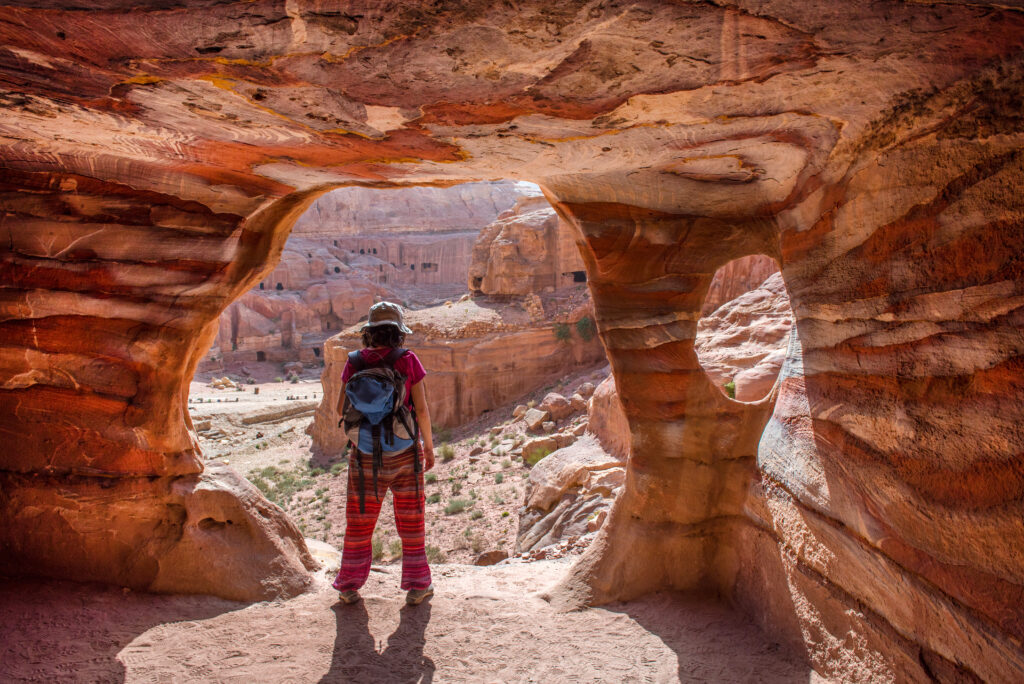

Discovering the Hidden Mysteries of Petra: A Journey Through Time

The rose-red city of Petra stands as one of humanity’s most extraordinary achievements, carved into the sheer sandstone cliffs of southern Jordan over two millennia ago. While millions know it as the backdrop to Indiana Jones’s quest for the Holy Grail, Petra’s true mysteries run far deeper than Hollywood could ever capture. This ancient metropolis, hidden for centuries from the Western world, continues to reveal secrets that challenge our understanding of ancient civilizations.
The Lost City Rediscovered
For nearly a thousand years, Petra existed only in local Bedouin legend and obscure historical texts. The Swiss explorer Johann Ludwig Burckhardt, disguised as an Arab scholar, became the first European to document the site in 1812. He convinced his Bedouin guide to take him to the tomb of Aaron, the brother of Moses, and in doing so, he “discovered” what the Bedouins had known all along—a vast city carved into rose-pink cliffs.
But calling Petra “lost” is a misnomer. The Bedouin tribes, particularly the B’doul people, had inhabited and protected these ruins for generations. They understood that this place held power, even if they couldn’t fully grasp the scope of what their ancestors had built. Today, as archaeologists continue their work, we’re learning that even our modern understanding barely scratches the surface.
The Nabataeans: Masters of the Desert

The true mystery of Petra begins with the Nabataeans themselves—an Arab people who transformed a harsh desert landscape into a thriving commercial hub. Between the 4th century BCE and the 2nd century CE, they controlled the incense trade routes that connected Arabia, Egypt, India, and the Mediterranean world. But how did a nomadic people develop such sophisticated architectural and engineering skills?
The Nabataeans were hydraulic geniuses. They created an intricate water management system that could capture and store the desert’s infrequent rainfall, supporting a population estimated between 20,000 to 30,000 people at its peak. Terra cotta pipes, cisterns, and channels carved into rock faces directed water throughout the city. Some channels were so precisely engineered that they maintained a constant gradient over kilometers, preventing erosion while maximizing flow.
This wasn’t just practical engineering—it was a statement of dominance over nature itself. In a region where water meant power, the Nabataeans essentially performed magic, making the desert bloom and transforming Petra into an improbable oasis.
Beyond the Treasury: Petra’s Hidden Architecture
Most visitors to Petra never venture beyond the famous Treasury (Al-Khazneh), perhaps exploring the Street of Facades and the Roman Theater before turning back. But this is where Petra’s real mysteries begin to unfold.
The Monastery (Ad-Deir): Larger than the Treasury and requiring an 800-step climb to reach, the Monastery raises fascinating questions. Its façade spans 50 meters wide and stands 45 meters tall, yet scholars still debate its original purpose. Was it a temple, a meeting hall, or a tomb? The single chamber inside offers few clues, its walls worn smooth by centuries of wind and sand.
The High Place of Sacrifice: Atop Petra’s highest accessible peak lies a carefully leveled platform with drainage channels carved into the rock. Here, the Nabataeans performed rituals we can only guess at. The precision of the rock-cutting suggests ceremonies of great importance, yet the archaeological record remains frustratingly silent about what occurred here.
The Royal Tombs: These massive façades—the Urn Tomb, the Silk Tomb, the Corinthian Tomb, and the Palace Tomb—showcase an evolution in architectural style that suggests changing religious beliefs or external influences. Some chambers contain dozens of burial niches, hinting at complex funerary practices we don’t fully understand.
The Mystery of the Unfinished Facades
One of Petra’s most haunting features is its unfinished monuments. Throughout the site, you’ll find partially carved façades and tombs, frozen mid-creation. The process is visible: workers started at the top and carved downward, using the rock face itself as scaffolding. But why were so many left incomplete?
The conventional explanation points to Petra’s decline after the Roman annexation in 106 CE and the shift in trade routes following maritime expansion. Yet some unfinished tombs show signs of sudden abandonment—tools left behind, work stopped mid-stroke. Were there earthquakes? Economic collapse? Plague? The silence of the stones keeps this secret well.
The Djinn Blocks: Ancient Sentinels
Before you even enter the Siq—the narrow gorge leading to the Treasury—you encounter massive cube-shaped monuments called Djinn Blocks. The Bedouins named them after supernatural beings, and no wonder: these geometric structures, some standing over 8 meters tall, offer no entrance and no inscription. Were they religious symbols? Tombs? Territorial markers?
Recent theories suggest they might represent Nabataean deities, specifically Dushara, the primary male god, often depicted as an uncarved stone block. But twenty-six such blocks exist around Petra, and their precise purpose remains one of the site’s enduring enigmas.
Hidden Chambers and Underground Secrets
Modern technology has revealed that much of Petra remains unexplored. Ground-penetrating radar and satellite imaging have detected structures beneath the sand, including what appears to be a massive ceremonial platform near the city center, buried under centuries of sediment.
In 2016, archaeologists announced the discovery of a huge platform measuring 56 by 49 meters, built atop a smaller platform, with no obvious parallels in the Nabataean world. Its discovery so close to Petra’s center, yet completely hidden, raises an uncomfortable question: how much more of Petra lies waiting beneath our feet?
The Petra Papyri: Recent Revelations
In December 1993, a remarkable discovery occurred when archaeologists found charred papyrus scrolls in a Byzantine church within Petra. These Petra Papyri, dating from the 6th century CE, have provided unprecedented insight into daily life long after the Nabataeans.
The documents reveal a community still thriving under Byzantine rule, with complex land transactions, inheritance disputes, and business dealings. But they also hint at tensions—religious conflicts, administrative corruption, and the gradual abandonment that would eventually leave Petra to the silence of the desert.
The Question of Belief
Perhaps Petra’s deepest mystery concerns the spiritual life of its creators. The Nabataeans left no written theology, no explanatory texts about their beliefs. We know they worshipped Dushara and his female counterpart Al-Uzza, but the nature of their rituals, their creation myths, their understanding of death—all of this remains speculative.
The architecture itself suggests a complex relationship between the living and the dead. Many “tombs” contain features suggesting they were also used for feasting and celebration. Were these death cults? Ancestor worship? The blending of the two? The triclinia (dining halls) carved near many tombs hint at elaborate funeral ceremonies, but the details have been lost to time.
Modern Mysteries and Conservation Challenges
Today, Petra faces mysteries of a different kind. How do we preserve sandstone that has stood for two millennia but now faces unprecedented threats from tourism, climate change, and water erosion? Over 1 million visitors annually traverse the ancient stones, their footsteps gradually wearing away irreplaceable surfaces.
The iconic rose-red color itself is fading in some areas, bleached by sun and scoured by wind-borne sand. Conservationists face an impossible dilemma: restrict access and protect the stones, or allow humanity to experience this wonder, knowing each visit hastens its decline?
What Lies Ahead
Only about 15% of Petra has been properly excavated and studied. The vast necropolis, the residential areas, the workshops—most remain buried or unexplored. Each archaeological season brings new questions, new puzzles, new reasons to reconsider what we thought we knew.
Recent discoveries suggest Petra was much larger than previously believed, with suburbs and satellite settlements extending far beyond the traditional site boundaries. LiDAR surveys have revealed agricultural terraces, water systems, and building foundations invisible to the naked eye, suggesting a population and sophistication that exceeded even generous estimates.
Conclusion: The Mystery Endures
Petra’s greatest mystery might be its ability to keep revealing new mysteries. Every answer spawns a dozen new questions. Who carved the enigmatic “Zibb Fir’aun” (Pharaoh’s Phallus) tomb? Why does the Treasury align with the winter solstice sunrise? What happened to the Nabataean written records—did they ever exist?
The rose-red city stands as a monument to human ingenuity, ambition, and artistry, but also as a humbling reminder of how much of the past remains unknowable. Perhaps that’s appropriate. Some mysteries deserve to remain mysterious, not from lack of effort, but because they remind us that every stone has stories it has yet to tell.
For those who venture beyond the tourist trail, who climb to the High Place at dawn or explore the back valleys where few visitors tread, Petra offers something rare in our over-documented world: genuine wonder. It’s a place where the past feels present, where questions outnumber answers, and where the journey of discovery continues, one carefully placed footstep at a time.
The desert keeps its secrets well, and Petra—eternal, enigmatic, extraordinary—remains the greatest secret of all.